
In CoinTracking you have the ability to edit or delete transactions, either by individual selection or by setting conditions for a Bulk Edit/Delete.
To edit or delete transactions, go to Transactions.

Warning: Always create a backup before deleting or editing transactions in your account. Otherwise, you will not be able to restore your data if something goes wrong!
Please note that support cannot delete transactions on your behalf. Instead, you will be guided on how to delete them yourself using the methods described in this article.
This article is separated into six sections:
1) Delete transactions by selection
2) Delete transactions by setting conditions (Bulk Delete)
3) Edit single transaction
4) Edit multiple transactions
5) Edit transactions by setting conditions (Bulk Edit)
6) Prevent duplicate imports & manage API/exchange syncs
1) Delete by selection
This option is useful if you want to delete a small number of transactions.
To delete a transaction, tick the white box to the left of the transaction line and click 'Delete'.
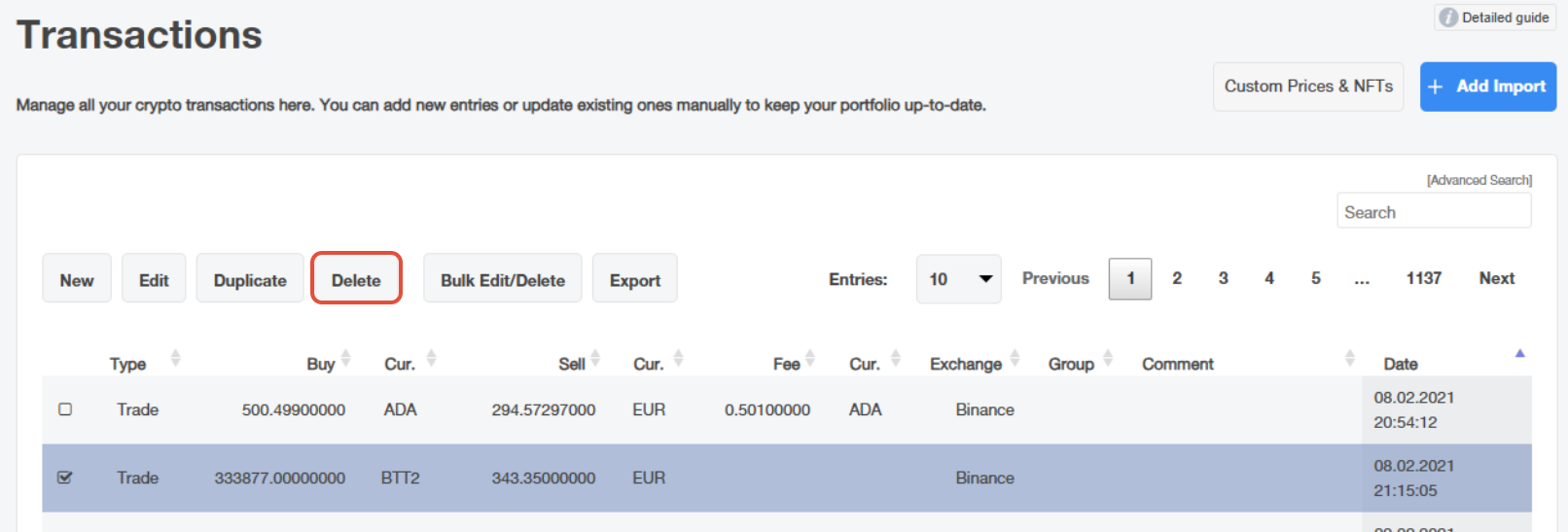
If you want to delete more than one transaction, hold down the CTRL key on your keyboard and select the transactions by ticking the white boxes on the left.
Afterward, click on delete.
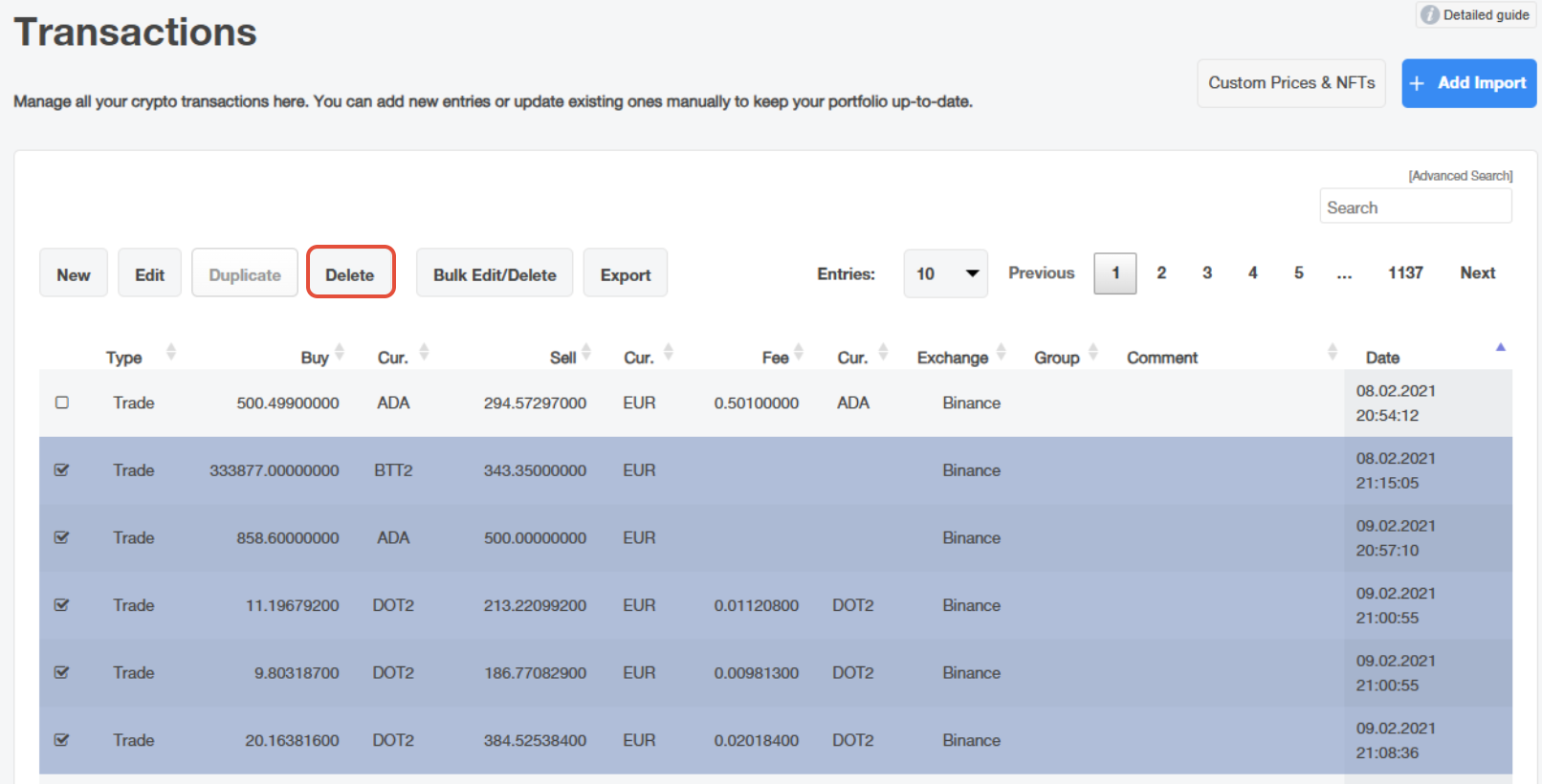
You can also delete the entire page by holding down the SHIFT key and selecting the first and last transactions on the page:
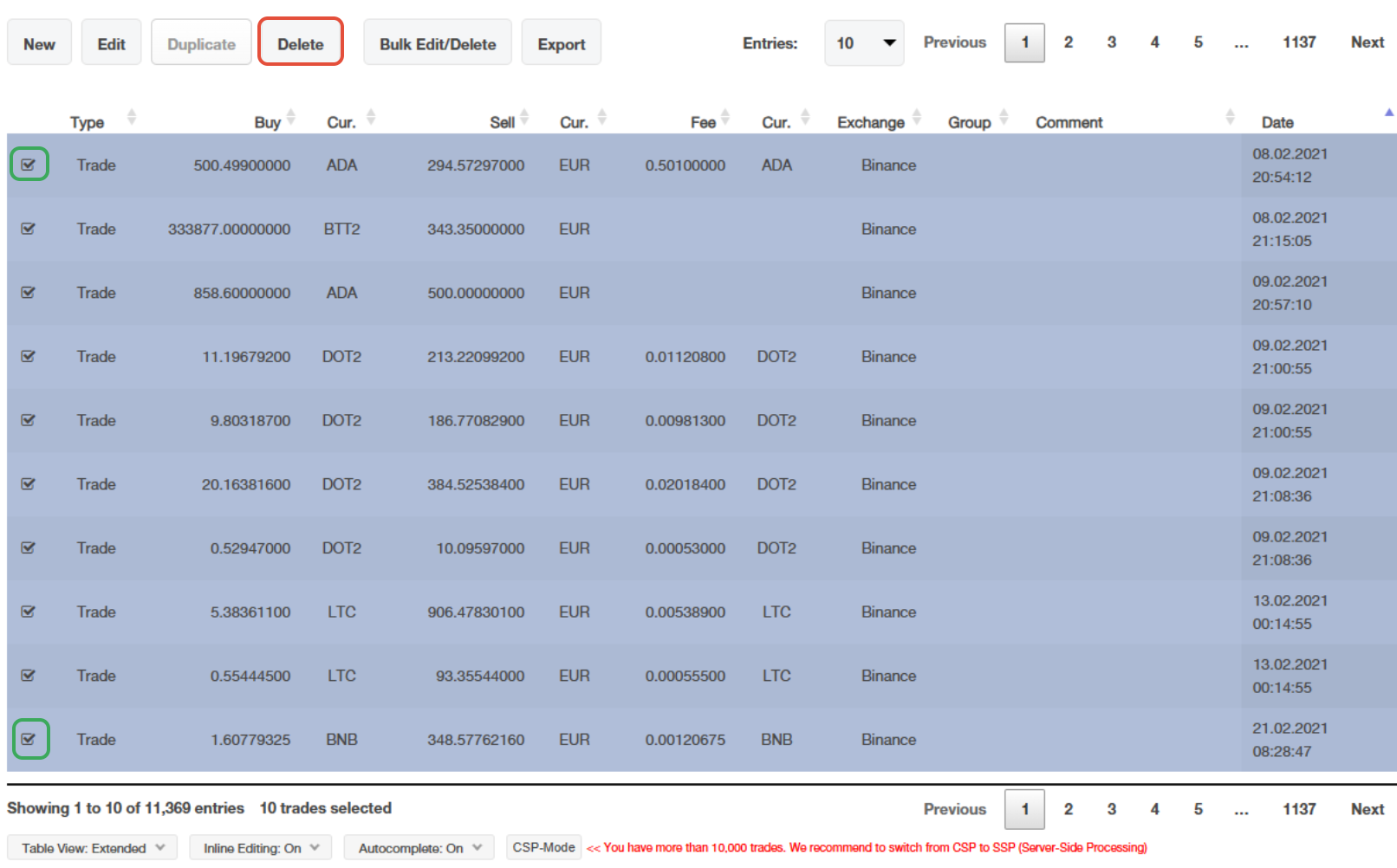
You can use this method to select transactions across several pages.
Hold down the SHIFT key, select the first and last transactions and move to the next page. You can select up to 500 transactions in this way.
Please note that you can only select multiple pages of transactions when using the CSP mode on the Transactions page:

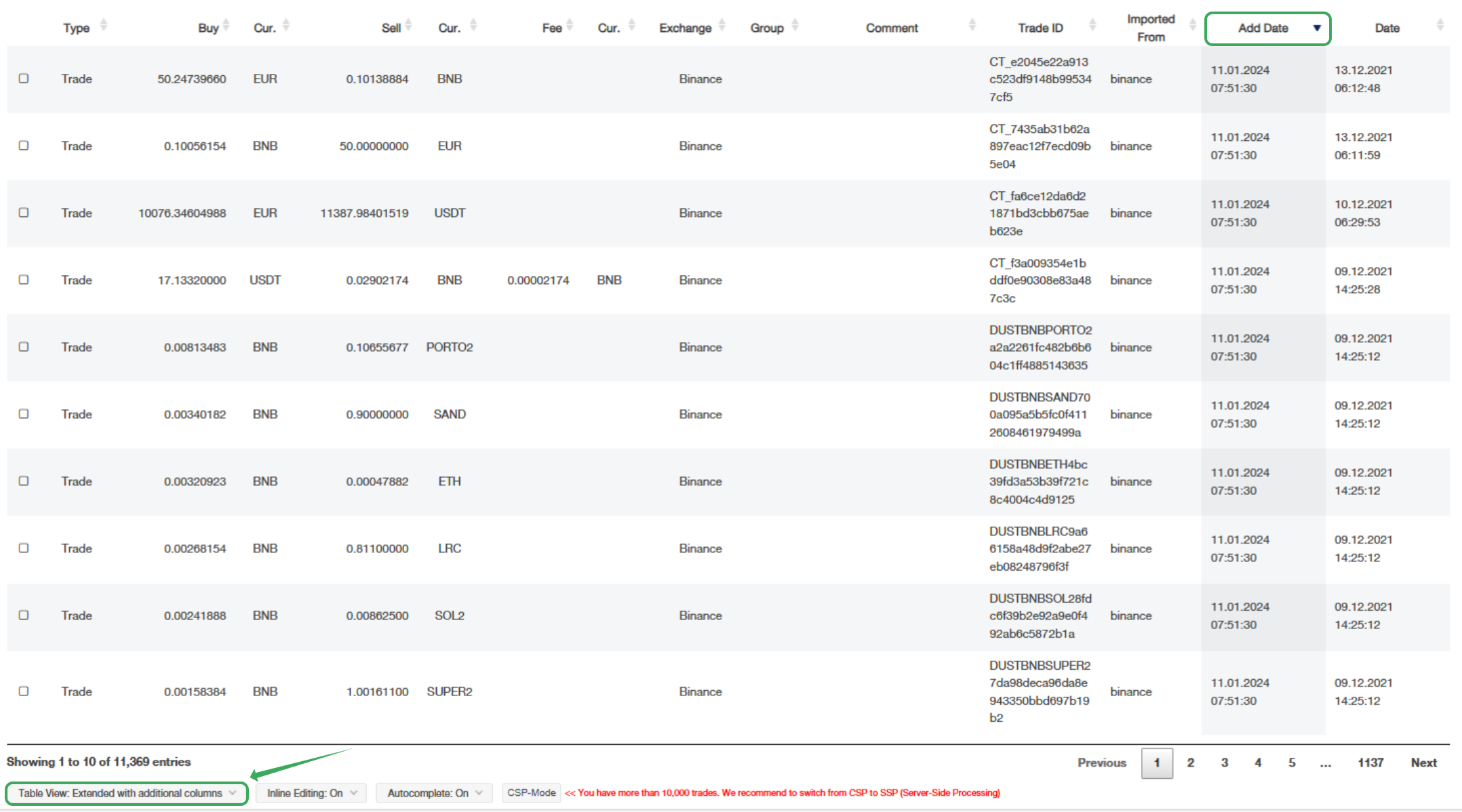
Another method is to individually delete your recently imported transactions. Therefore, go to Transactions and set your table view to "Extended with additional columns." Here, you can sort by import date by clicking the arrows under "Add Date."
How do I filter the Trade List by a specific exchange to review imported transactions?
If you only want to review or select transactions from one exchange or wallet (for example, before a bulk delete), switch the Transactions page to Full View and use the exchange filter/search field above the trade list to filter by the exchange name. This lets you check exactly which transactions were imported from that source before deciding to edit or delete them.
2) Delete by conditions
Use this option if you want to delete a large number of transactions.
We have created a quick guide to show you how to delete all your transactions or how to delete transactions by wallet/exchange. Additionally, you can set further conditions.
3) Edit single transaction
When it comes to editing transactions, you have multiple options.
First, we will explain, how to edit a single transaction.
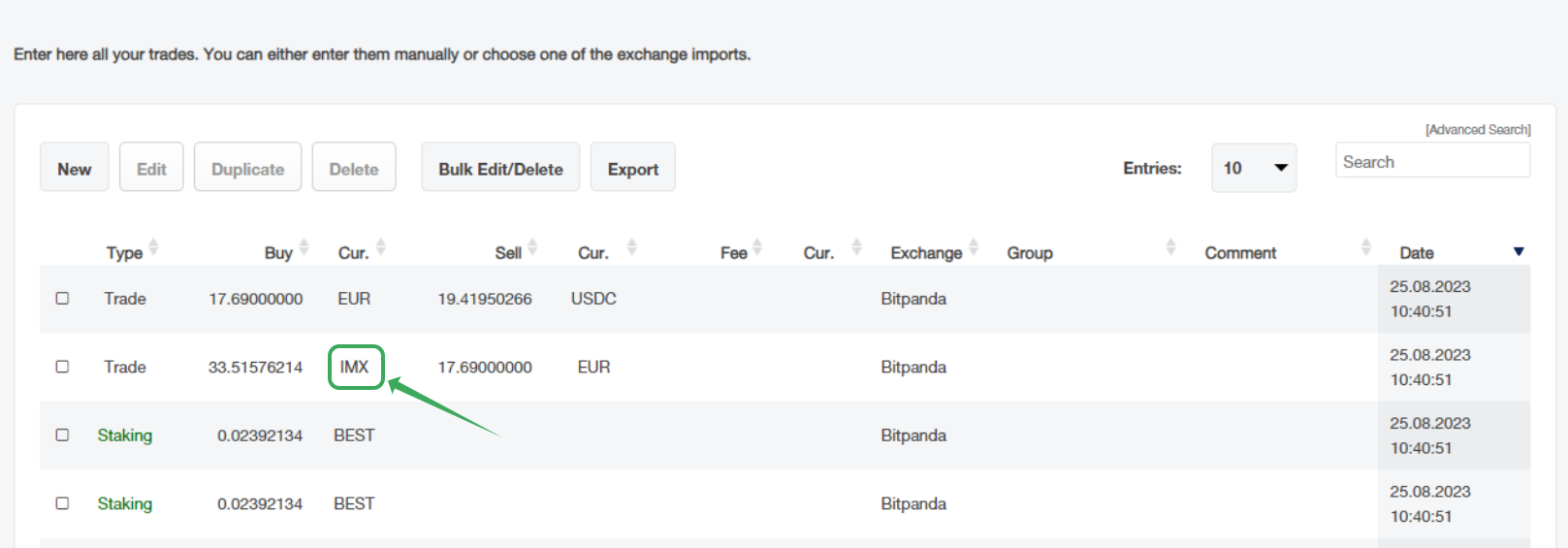
The quickest way to edit a transaction, is to directly click on the value that needs to be changed.
In this example, we will edit the currency of a transaction.
Click on the currency:
You can now change your trade currency:
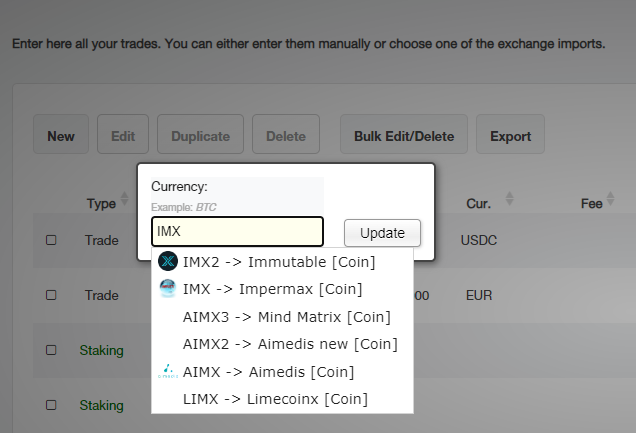
Note that this way of editing a transaction is limited and does not provide you with all the editing options, such as changing the transaction type.
To edit a transaction with all available options, tick the white box to the left of the transaction line and click 'Edit'.
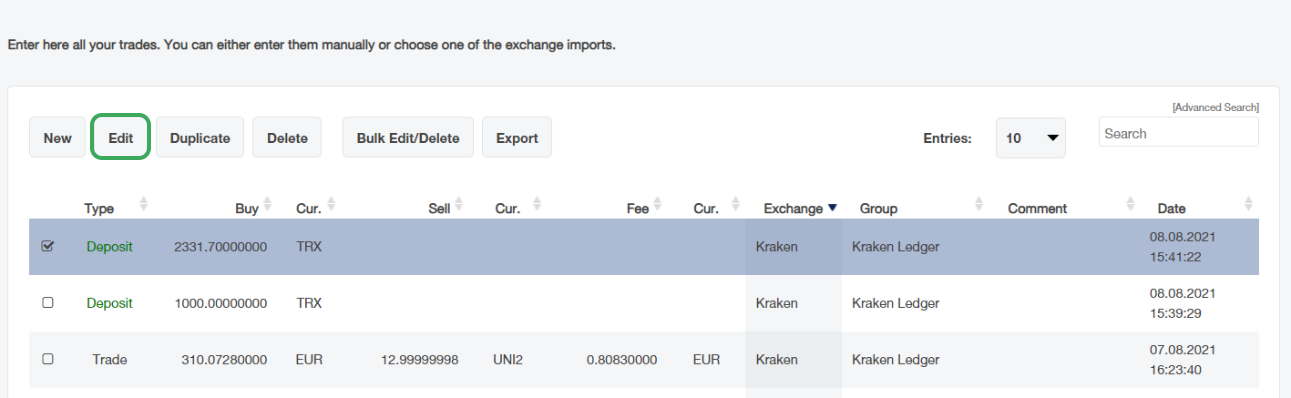
A window will open allowing you to change the transaction type or other values of the transaction.
Once you have edited your transaction, click on "Update".

4) Edit multiple transactions
Please note that this feature is for advanced users. We highly recommend creating a backup before you start this process!
To select multiple transactions, please refer to the methods mentioned in Section 1) Delete by selection where we explain how to select multiple transactions using SHIFT, CTRL etc.
Only edit multiple transactions of the same transaction type (e.g. editing multiple trades).
When editing multiple transactions, you can either keep the individual values for your transactions or set new values.
In this example, we are going to edit the trade currency for three transactions to Bitcoin:
Select multiple transactions of the same transaction type and click 'Edit' to open this window:
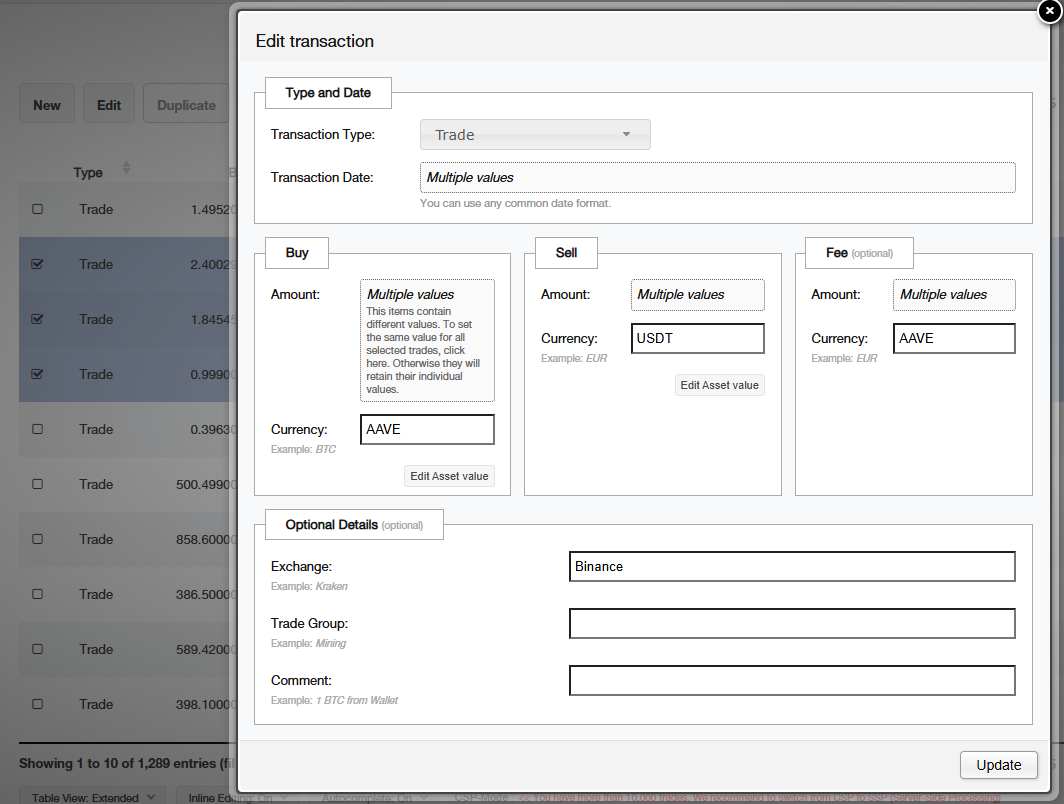
If the fields marked with "multiple values" are left unchanged, the processed transactions will retain their individual values for these fields.
If you want to change the values, click on "Multiple Values" and enter your new values.
All the transactions you are editing will now have these new values.
In this example, we will change the currency to Bitcoin (on the buy side).
On the buy side, go to the currency field and click on "Multiple Values".
Then enter "Bitcoin" as the new currency and click "Update".

You have now successfully changed the currency to Bitcoin.
Please note that you may need to adjust other information such as the Asset Value, the Sell Amount or the Trading Fees in order for your edited trades to be set up correctly.
If this process is too difficult, please edit your transactions one by one or check the Bulk Edit/Delete feature below.
5) Edit transactions by setting conditions (Bulk Edit)
Use this feature if you want to edit a large number of transactions.
You have the option to edit transactions by setting different conditions.
Click on "Bulk Edit/Delete"
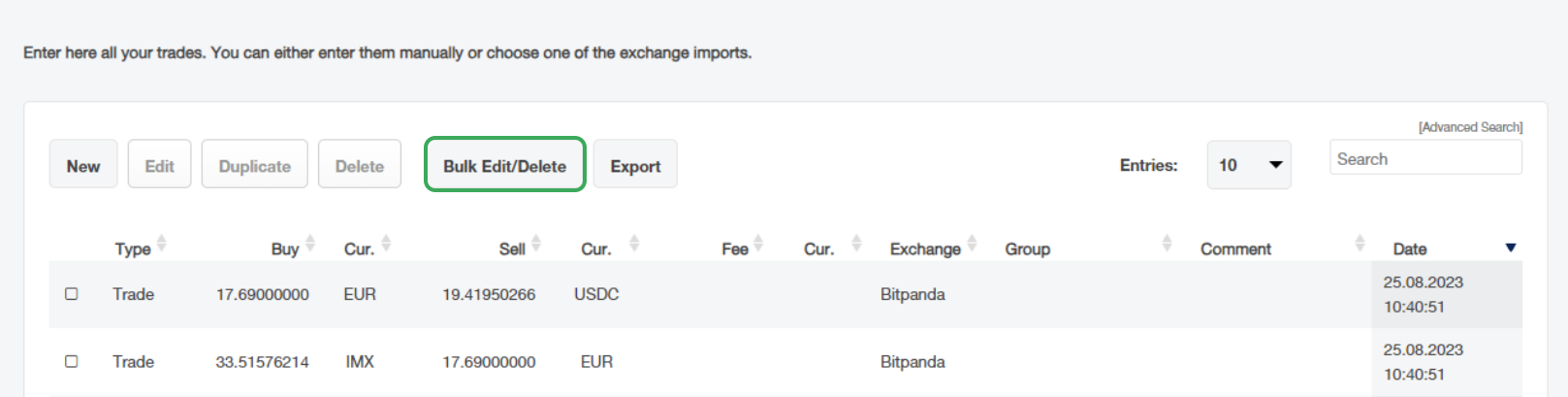
Go to Bulk Edit.

We have created easy-to-follow step-by-step guides for each editing process:
- Change Exchange Name
- Change Trade Group
- Change Comment
- Change Trade Type
- Overwrite Coins
- Adjust trade time
- Set price per unit
- Convert to NFT
How do I merge duplicate exchange entries caused by different capitalization (e.g. "binance" vs "Binance")?
If the same exchange appears twice in your account with different spelling or capitalization (for example "binance" and "Binance"), this usually happens because transactions were imported under slightly different exchange names. To merge them into a single exchange entry, use the Change Exchange Name Bulk Edit feature linked above to rename all affected transactions to one consistent exchange name.
6) Prevent duplicate imports & manage API/exchange syncs
Why do deleted transactions reappear after an API/exchange sync?
If you delete transactions that were originally imported through an exchange API or a recurring CSV/API import job, the same transactions can reappear the next time the sync runs. This happens because, by default, an import job fetches your entire available trade history from the exchange again, including transactions you already deleted.
In the past, a technical issue with certain tickers/coins during import could also cause duplicate transactions to reappear on sync; this has since been fixed. If you still notice duplicates reappearing after a sync, please contact support so it can be reviewed.
How do I set a Start Date to prevent re-importing deleted transactions?
To stop an API or exchange import job from re-importing transactions you've already deleted, set a Start Date on the job:
- Go to Transactions and open your list of exchange/API imports.
- Click on the exchange/API job you want to adjust and select Edit.
- Locate the Start Date field in the import job settings.
- Set the Start Date to a date after the last transaction you deleted (so the job will only import transactions from that date forward).
- Save/update the job, then run the sync again.
Example for Binance: Open the Binance API job from your list of connected exchanges, click Edit, go to the Import Settings, enter a Start Date after the deleted transactions, and save the job. On the next sync, Binance transactions before that date will no longer be re-imported.
How do I export transactions from BingX for import?
When exporting your history from BingX for a manual import, make sure to:
- Select the correct time range/period you want to export.
- Choose Transaction History (not "Tax Data") as the export type.
- Export the file as CSV or Excel. Both formats are supported. If you run into issues importing the CSV file, try exporting as Excel instead, as this format is also supported by CoinTracking for BingX.
Once exported, import the file into CoinTracking as usual.