
1. General Information About the Report
What is a Crypto Source of Funds report?
A Source of Funds report traces the origin of a specific cryptocurrency withdrawal. The transaction history is analyzed backwards across multiple levels in order to reconstruct how and where the withdrawn funds were originally acquired.
Why is such a report needed?
The report typically serves as evidence for banks, tax authorities, revenue offices, or compliance bodies in order to disclose the origin of crypto funds. It can also be used to prepare tax filings.
What information does a Source of Funds report contain?
The report displays all individual transactions that led to the analyzed withdrawal. It maps the entire flow of funds as a single, connected "single flow" – from the original source of funds all the way to the final withdrawal.
2. Methodology and How It Works
Which method is used for tracing?
The report uses the FIFO method (First In, First Out). Starting from the analyzed withdrawal, the transaction chain is processed backwards, with each outflow being matched to the earliest available inflow.
What does "Level" mean in the report?
The level indicates the depth of tracing. Level 1 is the analyzed withdrawal itself. Level 2 shows where these funds came from, level 3 their predecessors, and so on. The deeper the level, the further back the flow of funds is traced.
What are "terminal deposits"?
Terminal deposits (highlighted in green in the report) are the original sources of funds – the last traceable point in the transaction chain. They mark where the funds first entered the traced chain.
What does the percentage "Share" mean? The share indicates which portion of a transaction's funds contributed to the traced withdrawal.
3. Glossary
Level: Indicates the depth of tracing. Level 1 is the analyzed withdrawal. Level 2 shows where these funds came from, and so on.
Inflow: Cryptocurrency or fiat currency received in a transaction (deposits, trade acquisitions, rewards).
Outflow: Cryptocurrency or fiat currency sent or converted in a transaction (withdrawals, trade disposals, fees).
Trade: An exchange of one cryptocurrency or fiat currency for another.
Deposit: Funds received from an external source onto an exchange or wallet.
Withdrawal: Funds sent from an exchange or wallet to an external destination.
Share: The percentage portion of a parent transaction's funds that is allocated to a child transaction in the trace.
Terminal deposits: A transaction representing an original source of funds — the last traceable point in the chain.
Missing: A transaction that could not be fully traced due to incomplete data imports or rounding differences.
4. Using the Report
Does the report constitute financial or tax advice? No. The report is provided for informational purposes only and does not constitute financial, tax, or legal advice. Additional documentation and professional consultation may be required for regulatory or compliance purposes.
The Source of Funds report can be accessed via the link provided.
5. Concrete Example
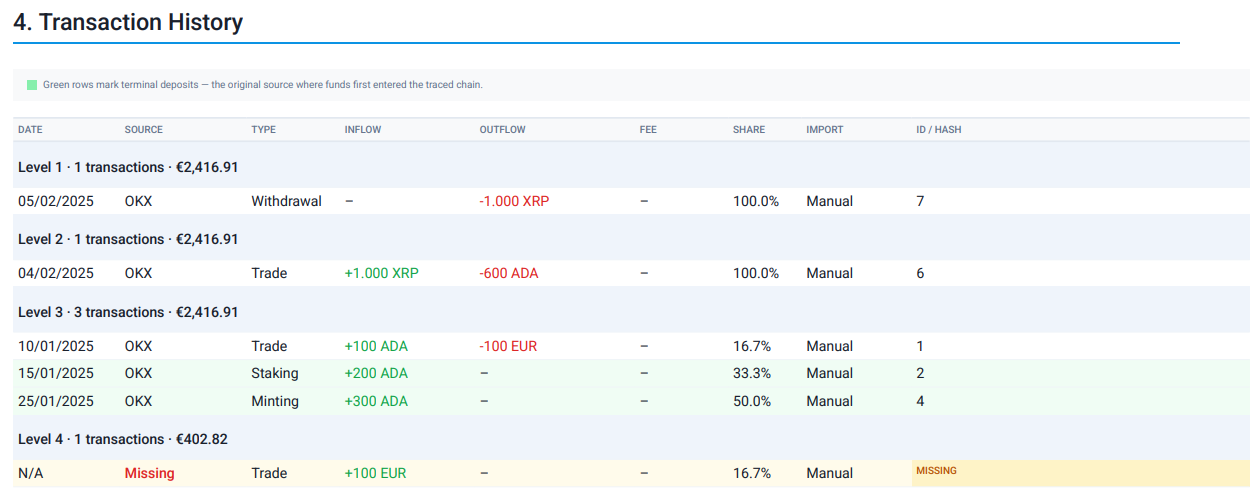
To make the functionality more tangible, here is a complete example based on a real report.

Starting point (Level 1):
On 02/05/2025, a withdrawal of 1,000 XRP (€2,416.91) was made via OKX. This withdrawal is the starting point – from here, the report works its way backwards through the transaction history.

First step back (Level 2):
At this level, the report shows where the 1,000 XRP came from: 02/04/2025 – Trade: +1,000 XRP for −600 ADA on OKX (Share 100%). This means: The withdrawn XRP were acquired one day earlier through a swap of 600 ADA. The report must now clarify where these 600 ADA originated.

Second step back (Level 3):
Here are the three final deposits that together make up the 600 ADA:
01/10/2025 – Trade: +100 ADA for −100 EUR (Share 16.7%)
01/15/2025 – Staking: +200 ADA (Share 33.3%)
01/25/2025 – Minting: +300 ADA (Share 50.0%)
In total: 100 + 200 + 300 = 600 ADA → exactly the amount that flowed into the XRP trade.

Third step back (Level 4):
The EUR trade from 01/10 is examined one level deeper: Where did the 100 EUR come from? Since this information is missing from the dataset, the report shows a "Missing" transaction with a share of 16.7%.

What does this tell us?
The 1,000 XRP are economically composed of three sources: a small EUR purchase, a staking reward, and a minting credit. The history of the fiat portion is not fully traceable.
Pool Composition and Percentage Distribution
What is the Pool Composition? The pool composition describes the proportional sources from which the withdrawn funds are made up. It answers the question: Which "pools" do my coins come from – and what percentage comes from which pool?
How to Read the Report – With an error in the data
To make the functionality tangible, here is a complete walkthrough example based on a real report. Deliberately chosen: a case in which the underlying data is not complete. This way, it can also be demonstrated how the report makes such gaps visible.

Starting point (Level 1):
On 02/05/2025, a withdrawal of 1,000 XRP (€2,416.91) was made via OKX.

First step back (Level 2):
The report shows where the 1,000 XRP came from: 02/04/2025 – Trade: +1,000 XRP for −600 ADA on OKX (Share 100%).

Second step back (Level 3) – here the gap appears: The report lists four final deposits whose total must equal the 600 ADA.
Date | Type | Inflow | Share |
| 10/01/2025 | Trade (100 EUR → ADA) | +100 ADA | 16,7 % |
15/01/2025 | Staking | +150 ADA | 25,0 % |
25/01/2025 | Minting | +300 ADA | 50,0 % |
N/A | Missing | +50 ADA | 8,3 % |
What happened here?
The transactions imported into CoinTracking only add up to 550 ADA (100 + 150 + 300). However, the trade from 02/04 consumes 600 ADA. So 50 ADA are missing from the history, and their origin is not documented.

CoinTracking automatically fills this calculated gap with "Missing." This way, the report remains internally consistent (the totals add up again), while the gap is transparently flagged as such.
How to Handle Such a Report
Identify gaps: The "Missing" entries show exactly where data is missing – here 50 ADA at level 3.
Review the original data: A look at the OKX transaction list typically reveals what was not imported – e.g. a forgotten crypto deposit from another wallet (the missing 50 ADA). Further help can be found in the related FAQs.
Warnings In The Capital Gains Report
Working with the Transaction Flow Report
Add missing data: The missing transactions can be added via CSV import, API connection, or manual entry.
Regenerate the report: After the correction, the "Missing" entries disappear, the share of "Other Sources" is cleanly distributed across the correct categories, and the trace completeness rises to 100%.
Important to understand: A report with "Missing" entries is not "wrong" – it is honest. It clearly shows what is verifiable and what is not. Especially towards banks and authorities, this is more valuable than a seemingly seamless report whose gaps have merely been made invisible.