
TL;DR:
Staking, LP staking, and masternode transactions can be recorded either by tracking only the rewards or by logging the entire process including deposits, withdrawals, and conversions. For tokens that change when staked (e.g., ETH to ETH2), you can use a “Swap” entry to keep it non-taxable or a “Trade” entry if taxable, which also resets the holding period. If a staking reward token isn’t listed on CoinTracking (e.g., XGRAIL, HEGIC-related staking tokens, or obscure tokens like N-7JUTS), you can set a Custom Price or use Force Custom Price so the transaction is valued correctly. Masternode handling depends on whether the coins leave your control. If they do, record them as a spend plus income; if not, track them as transfers to and from the masternode wallet with rewards as income. Finally, keep in mind that Total Gain, Realized Gain, and Unrealized Gain in your reports can differ. This is expected and explained below.
1) Entering Staking Transactions
You can either:
Track only rewards (income entries), or
Track the full process: send to staking → earn rewards → unstake.
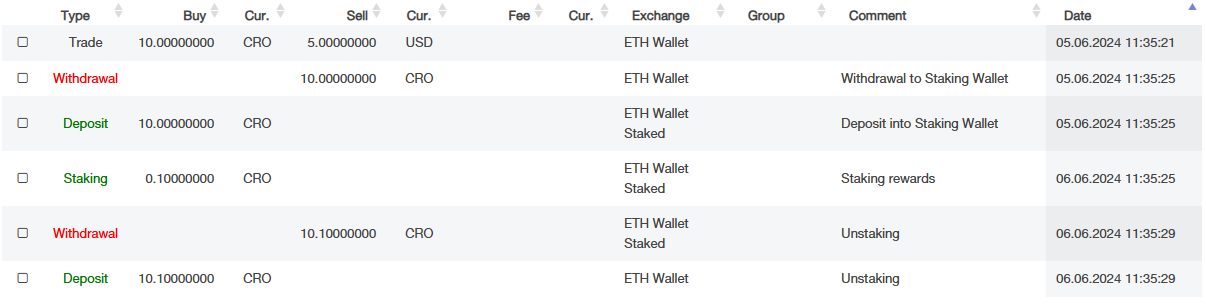
Example Flow:
CRO withdrawal from your wallet.
CRO deposit into staking wallet (staking).
CRO income/rewards in your wallet or staking wallet.
CRO withdrawal from staking wallet (unstake).
CRO deposit back into your wallet.
Token Conversions While Staked
Some tokens change tickers when staked (e.g., ETH→ETH2, ETH→stETH, SOL→xSOL). You can:
Swap (non-taxable): Keeps holding period, avoids capital gains/losses.
Trade (taxable): Resets holding period, may create gains/losses.
Unstaking: Reverse the process. Use Swap or Trade depending on tax treatment.
What if my staking reward token isn't listed or has no price?
Some staking or reward tokens are not listed on CoinTracking and therefore have no automatic market price. Common examples include XGRAIL, HEGIC-related staking tokens, or lesser-known tokens like N-7JUTS. In these cases:
Set a Custom Price for the coin so CoinTracking has a value to calculate gains/losses with.
If CoinTracking is picking up an incorrect or unwanted auto-detected price for the token, use Force Custom Price to make sure your manually entered price is used instead.
Combine this with your normal staking/income entry (see flow above) so the reward transaction is recorded with a correct valuation for your reports.
2) Entering LP Staking Transactions
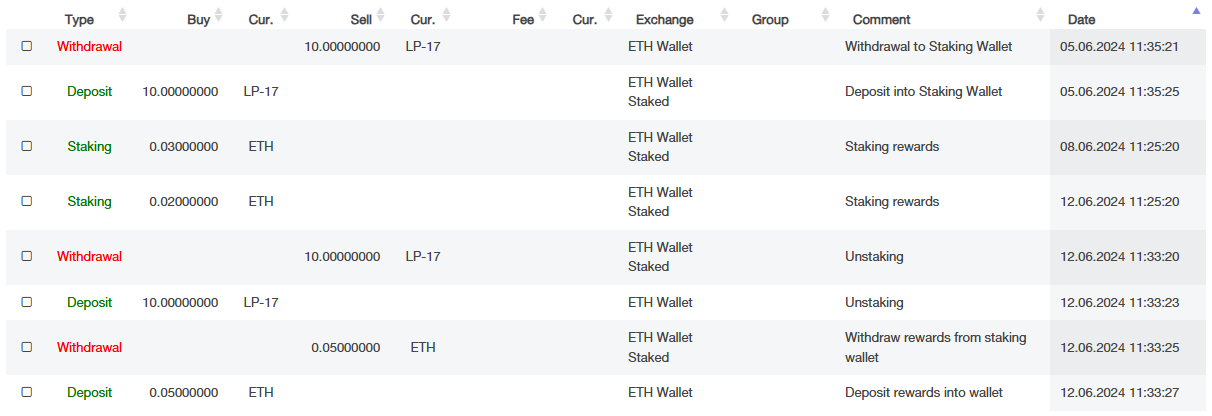
Same steps as staking, but with LP tokens:
LP withdrawal from your wallet.
LP deposit into staking wallet (staking).
LP income/rewards in your wallet or staking wallet.
LP withdrawal from staking wallet (unstake).
LP deposit back into your wallet.
3) Entering Masternode Transactions
If coins leave your possession:
Add the initial investment as Spend.
Add rewards as Masternode transaction type.
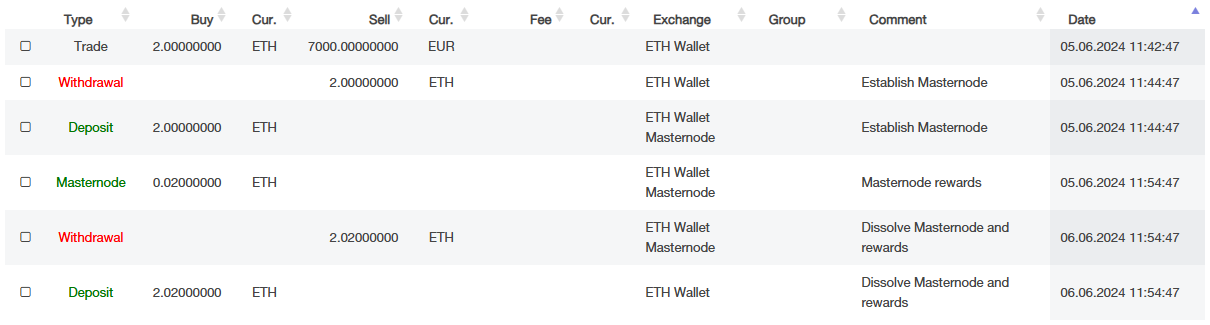
If coins remain in your possession: Example (ETH masternode):
Withdraw ETH from your wallet.
Deposit ETH into masternode wallet.
Add rewards as Masternode.
Withdraw ETH and rewards from masternode wallet.
Deposit them back into your wallet.
4) Why don't Total Gain, Realized Gain, and Unrealized Gain match?
After entering your staking, LP staking, or masternode transactions, you may notice that the Total Gain, Realized Gain, and Unrealized Gain shown in your reports don't add up the way you'd expect at first glance. This is normal and not an error:
Total Gain is the sum of Realized Gain and Unrealized Gain.
Realized Gain reflects profits or losses from coins that have already been sold, traded, spent, or otherwise disposed of. This includes staking or masternode rewards once they are moved out, converted, or sold.
Unrealized Gain reflects the current paper profit or loss on coins you are still holding, based on the difference between your cost basis and the current market price.
Because staking and masternode rewards are booked as income at the price on the day they're received, and then continue to fluctuate in value while you hold them, it's expected to see a difference between these three figures. This simply reflects the split between assets you've disposed of versus assets still sitting in your portfolio.
Summary
- Use the correct transaction type depending on whether coins leave your control.
- For staking token conversions, Swap = non-taxable, Trade = taxable.
- Track full stake/unstake flows if you want detailed reporting.
- For unlisted reward tokens (e.g., XGRAIL, HEGIC-related tokens, N-7JUTS), use Custom Price or Force Custom Price to ensure correct valuation.
- Total Gain = Realized Gain + Unrealized Gain. Differences between them are expected and reflect disposed vs. held assets.
- Consult your tax advisor when unsure of the correct classification.