
Introduction
Welcome to this guide on understanding and navigating your tax report. It is designed to explain the structure of the report and help you interpret the data in a clear and practical way.
Section 1: Settings
Before generating your report, you can configure various settings that directly impact the calculation. These include country selection, reporting period, and calculation logic. After generating the report, you will be guided to the overview described in Section 2.
The following are the most relevant settings for Portugal.
Accounting Method
CoinTracking provides multiple accounting methods:
FIFO (First-In-First-Out): The first assets acquired are treated as sold first
LIFO (Last-In-First-Out): The most recently acquired assets are treated as sold first
HIFO (Highest-In-First-Out): The assets with the highest acquisition cost are treated as sold first
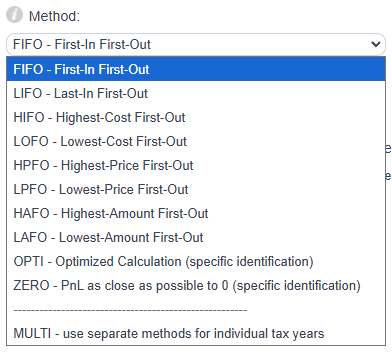
Each method has different tax implications.
FIFO assumes older assets are sold first and is widely accepted due to its simplicity
LIFO assumes newer assets are sold first and may be beneficial in declining markets
HIFO prioritizes selling assets with the highest cost basis to reduce taxable gains
Each method is suitable for different situations. Your choice should depend on your individual financial circumstances and applicable tax regulations.
FIFO is typically used in Portugal.
Automatic Depot Separation
Automatically assigns deposits and withdrawals to specific exchanges or wallets
Without this feature: all wallets and exchanges are treated as one combined portfolio
With this feature enabled: each wallet/exchange is treated as a separate portfolio
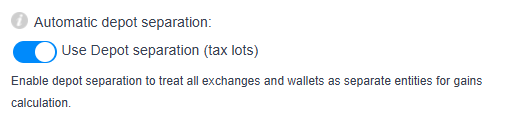
This allows for more precise tracking and evaluation of transactions.
Group by Day
Groups purchases and/or sales by day instead of exact timestamps
Useful when time zones were not recorded correctly and transactions appear out of order

FIAT Warnings
Displays a warning when assets are purchased in a FIAT currency not configured in the account

Foreign FIAT PnL
Enabled: Gains and losses from foreign FIAT currencies are treated like crypto gains/losses
Disabled: Only EUR-based gains/losses are included in the report

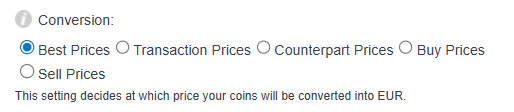
Conversion
All transactions that are not in your FIAT currency are converted into your FIAT currency at the time of the transaction.
This is required to:
Calculate gains and losses correctly
Ensure consistent tax reporting
A separate FAQ explains the available conversion methods in more detail.
Previous Trades
The setting “Consider all previous trades in report before your selected date” ensures that earlier transactions are included in the calculation.
This is important because:
Previous trades affect the cost basis of current transactions
Excluding them can lead to incorrect results
Enabling this setting ensures accurate and consistent calculations across your full transaction history.

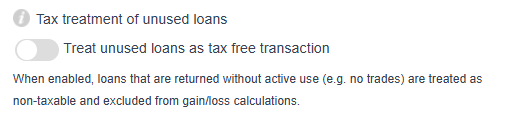
Tax Treatment of Unused Loans
By default, loans that are not actively used (e.g. not traded) and later returned are treated as tax-neutral with zero proceeds.
If this setting is disabled:
Gains and losses will be calculated
The transactions will be included in the tax report
Additional Settings
The platform offers many additional configuration options.
Each setting includes an “i” infobox
The infobox provides detailed explanations for that specific setting
These infoboxes help you understand and correctly configure your report settings.
Section 2: Overview
The tax report classifies transactions based on Norwegian tax regulations.
In Norway, cryptocurrencies are treated as capital assets, not as currency. This means that every disposal is a taxable event, regardless of the type of transaction.
Taxable events include:
Selling crypto for fiat
Crypto-to-crypto trades
NFT-to-NFT trades
Converting between tokens (including wrapped assets)
Using crypto to pay for goods or services
All of these are considered realization events and result in either:
A taxable gain, or
A deductible loss
The applicable tax rate on capital gains is 22%.
Wealth Tax
In addition to capital gains tax, Norway applies a wealth tax:
Crypto holdings must be reported at their value on January 1 of the following year
Applies to total net wealth above 1,700,000 NOK
Effective rate: approximately 1%–1.3%
Taxable Income from Cryptocurrency Trading
This section includes transactions where assets are disposed of.
Typical transaction types:
Trade
Spend
Fees paid in cryptocurrency
Remove liquidity
Provide liquidity
Example
A purchases 1 BTC for 10,000 EUR on 01.07.2025.
On 31.07.2025, the BTC is sold for 20,000 EUR.
→ Realized gain: 10,000 EUR
→ Reported under Section 1.1


Profits from Margin, Derivatives and Futures
These are treated as capital gains, as they result from the disposal of assets.
Included transaction types:
Margin gain / loss
Derivatives / futures gain / loss
Margin fee
Settlement fee
Example
Margin profit: 1,000 EUR
Margin loss: 500 EUR
→ Net gain: 500 EUR
→ Reported under Section 2.1


Income
Crypto income is taxed when:
You gain control over the asset
The value can be determined in FIAT
Typical transaction types:
Income
Reward / Bonus
Staking
Mining
Airdrop
Masternode
Dividends income
Lending income
Interest income
LP Rewards
Other income
Example
Staking reward: 0.5 BTC (value: 20,000 EUR)
Airdrop: 100 EUR
→ Taxed as income at 22%
→ Reported under Section 3.1


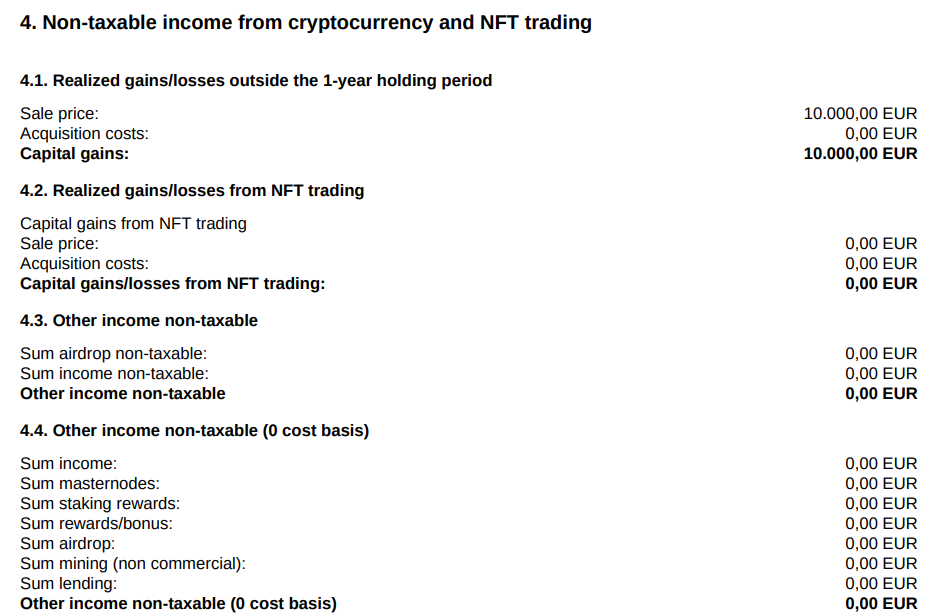
Non-Taxable Income
This section includes transactions that are not taxed but must still be reported.
Typical transaction types:
Income (non-taxable)
Airdrops (non-taxable)
→ Reported under Section 4
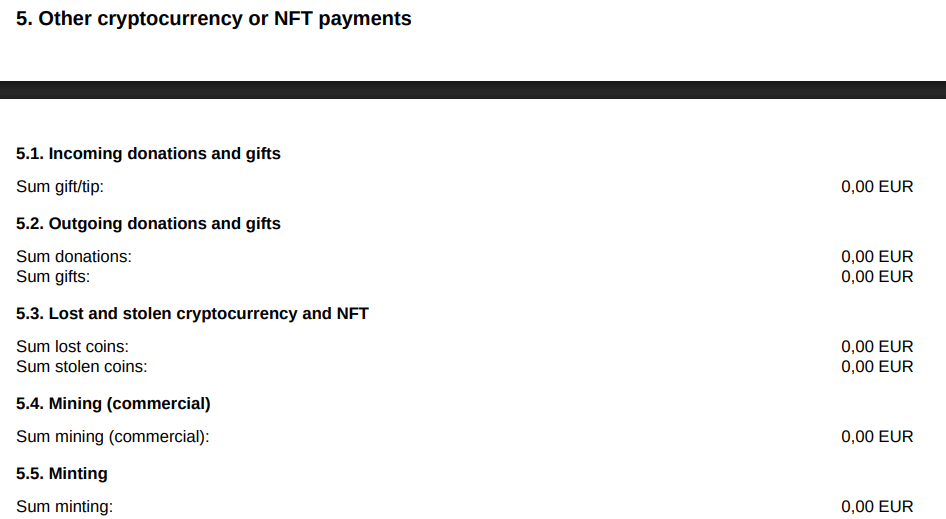
Other Cryptocurrency and NFT Payments
These transactions are listed separately due to different tax treatments.
Includes:
Donations and gifts (incoming and outgoing)
Lost or stolen assets
Commercial mining
Minting
Section 3: Transaction List
The Transaction List provides a detailed overview of all transactions within the selected period.
Summary
The tax report structure is divided into gains, income, and non-taxable categories
Settings directly influence how transactions are calculated
Choosing the correct accounting method is essential
Understanding transaction classification ensures accurate interpretation of the report
Disclaimer
This guide is for informational purposes only and does not constitute tax, legal, or financial advice. Tax laws may change. Please consult a qualified tax advisor for personalized advice.